The Still Center that is Existence

Reclaiming Wonder and the Silent Witness in the Age of Digital Noise
Summary: Those who grew up before the late 1980s carry a somatic memory of a world not yet flooded by constant digital input. In an era defined by cognitive light pollution and algorithmic noise, how do we protect the minds of the next generation? This essay explores how ancient Vedāntic and Daoist wisdom can help us step off the spinning edge of the digital wheel and reclaim the silent sanctuary of the Still Center.
There is a specific quality of space that those born before the late 1980s carry in their bones—a somatic memory of a world not yet flooded by constant digital input. Looking back, the absence of this technological hum wasn't a void, and it certainly wasn't boredom. It was the fertile ground for exploration and childlike wonderment.
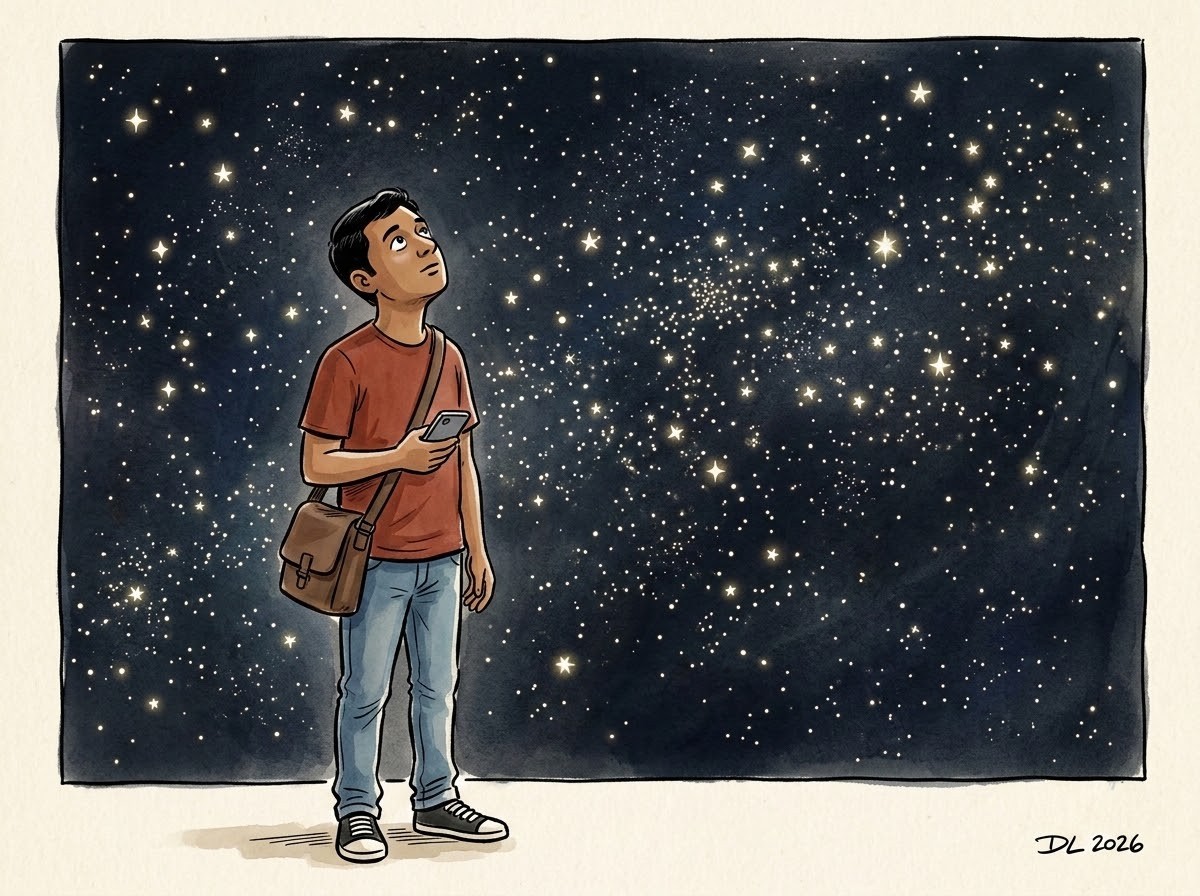
It was also literally expansive. I remember, as a child, the sudden, plunging darkness of the regular "load-shedding" events that defined that era. In those moments when the artificial grid failed, I would climb onto the portico of my house and lie flat on my back.
On a clear, new moon night, unhindered by city lights, the stars were innumerable, stretching out in a fathomless canopy. It felt as though I was looking directly into the body of the universe itself. The sheer scale of it didn't induce anxiety; it induced awe.
The stars, of course, were always there. But it took the death of the artificial lights for us to realize we were resting beneath the infinite.
Today, the youth of our world—Gen Z, Gen Alpha, and younger Millennials—are denied this cognitive load-shedding. They have grown up in the zeitgeist of an ever-expanding, ever-cacophonous swirl of information. We have replaced the awe of the infinite with the anxiety of the immediate.
There is no darkness to reveal the stars; their reality is perpetually backlit by the glare of screens, infinite scrolls, and algorithmic demands. We are witnessing an era of profound cognitive light pollution that is actively rewiring the brains of an entire generation.

The Centrifuge of Becoming
To understand what this cognitive light pollution is doing to our minds, we must look to an ancient metaphor shared by both Vedāntic and Daoist traditions: the wheel.
Imagine existence as a giant, spinning wheel. The outer rim is the world of phenomena—the ever-changing, endlessly moving realm of Saṃsāra. It is the domain of action, reaction, and the chaos of daily life. The center of the wheel, however, is the hub.
As Laozi observed in the Tao Te Ching, it is the empty, still space at the center that makes the wheel function. In Vedanta, this unmoving hub is Sat—Pure Existence, the silent Witness (Sākṣī).
For most of human history, society spun at a pace that allowed us to occasionally step back from the rim and rest in the hub. A quiet afternoon, a walk without a device, or even the sudden darkness of a power outage forced us inward. But the Information Age has fundamentally altered the physics of our daily lives.
We have built a machine that spins the wheel at an unprecedented, dizzying velocity.
When a wheel spins at high speed, it generates centrifugal force—a physical pressure that pushes everything outward, away from the center, trapping it on the edge.
This is precisely what modern technology does to human consciousness. The constant bombardment of micro-videos, algorithmic outrage, push notifications, and fragmented data acts as a cognitive centrifugal force. It violently flings our attention to the extreme outer edge of the wheel.
We are kept in a perpetual state of "becoming"—reacting, scrolling, consuming, anticipating—never allowed the unhurried space for simply "being."

The Neurological Hijack
For today's youth, this is not merely a cultural shift; it is a neurological rewiring. The human brain evolved to track movement and novelty as a survival mechanism. The digital zeitgeist exploits this vulnerability flawlessly, feeding the mind a diet of endless, rapid-fire stimuli.
By keeping consciousness pinned to the spinning periphery, the digital ecosystem creates a closed dopamine loop. The noise is so constant that the absence of it—the "white space" of the analog era—is no longer experienced as a gateway to wonder. Instead, it is experienced as a terrifying vacuum.
When the artificial light is momentarily turned off, the modern hyper-stimulated mind does not look up for the stars; it panics, feeling the acute withdrawal of the spinning rim.
The tragedy of the Information Age is that the periphery is inherently unstable. You cannot find balance on the edge of a rapidly spinning wheel—you can only hold on for dear life. The more information we consume in an attempt to feel grounded or informed, the faster the wheel spins, and the further we are thrown from the still center of our own existence.

The Universal Trap and the Imposed Silence
Lest those of us with analog childhoods feel insulated from this phenomenon, we must admit a humbling truth: we are just as susceptible to the centrifuge. The algorithm does not discriminate by age.
Social media platforms and news feeds are engineered to bombard us with raucous audio-visuals, inundating our senses with a relentless cadence of noise. Every ping, buzz, and red badge demands an immediate reaction, pulling our awareness outward. I don't know how others process this, but I found that living at the beck and call of these constant interruptions generated genuine, physiological stress.
The friction of the spinning rim was burning me out.
Several years ago, I realized I was losing my grip on my own attention. In an act of self-preservation, I disabled all notifications on my smartphone, except for direct voice calls and text messages.
I didn't throw the phone in the river—I still live and work in the modern world. But by silencing the noise, I effectively forced a cognitive load-shedding upon my own life. I turned off the algorithm's artificial light so that the quiet expansiveness of my own mind could become visible again.

Relocating to the Hub: The Practice of Sākṣī
This act of reclaiming our attention is where the ancient wisdom traditions offer a profound roadmap. We cannot stop the wheel of the Information Age from spinning. Technology will continue to accelerate, and retreating to a cave is not a viable option for most of us. The goal is not to destroy the wheel, but to change where we reside upon it.
In Vedanta, this practice involves relocating our identity from the agitated mind to the Sākṣī—the silent Witness. The Witness is the part of you that is aware of the noise, aware of the stress, and aware of the scrolling, yet remains completely untouched by it. It is the pure awareness that watches the mind react.
When you feel the stress of a notification or the pull of the endless feed, the instinctive reaction is to lean forward, to engage, to run faster on the rim of the wheel. The contemplative practice is to do the exact opposite: to lean back.
You observe the urgency without acting on it. You notice the noise without letting it dictate your internal rhythm. By resting in the Sākṣī, you step off the dizzying periphery and slide inward toward the hub—toward Sat, or Pure Existence.

The Architecture of "No Thing"
But how does one actually rest in the Sākṣī amidst the demands of modern life? Going cold-turkey—abandoning our devices and retreating entirely from the digital world—is not a viable option. The momentum of the spinning rim is too strong to halt abruptly.
Instead, the return to the hub must be gradual and intentional. It begins by making a habit of sitting in quietude, free of distractions, for just five minutes a day at a specific, designated time. Once this baseline is established, you designate two such periods. Slowly, you progress to four.
Even twenty minutes of genuine silence and stillness interspersed throughout the day will prove profoundly nourishing. It is not so hard to do, once we deliberately set our minds to it.
There will, of course, be discomfort at first. We have been conditioned to fear the absence of input. Because we are so accustomed to the centrifuge, the sudden stillness will feel alarming; the mind, starved of its algorithmic dopamine, will desperately demand a task. People are simply no longer used to doing "nothing."
For those who are absolutely unable to sit still for even five minutes, a moving meditation like Taijiquan or Qigong offers a gentle entry point. In these disciplines, the body engages in slow, deliberate action, but the awareness remains anchored. It is the physical realization of our wheel metaphor: the limbs trace the gentle arcs of the periphery, while the mind rests securely in the unmoving hub of the breath.
It allows a hyper-kinetic mind to process its residual nervous energy while gradually tethering itself to the present moment.
Ultimately, that "no thing" we fear is vital. It is akin to deep sleep for the waking consciousness—a necessary, restorative state that allows our brains and minds to self-cleanse, washing away the accumulated cognitive light pollution of the day.
In those deliberate minutes of quietude, whether seated or in motion, we are not running away from existence; we are sinking into it. We are intentionally recreating the load-shedding of a bygone era. We are choosing, if only for five minutes at a time, to turn off the artificial glare so that the infinite, quiet expanse of the Still Center can finally reveal itself.

No reflections yet. Be the first to share your thoughts!